China Expands Humanoid Robot Patent Share to 60.8% of Global Total
On September 28, 2026, data from China's Ministry of Industry and Information Technology showed that Chinese institutions hold 60.8% of all global humanoid robot patents, up from 52% a year earlier. The country filed over 34,000 humanoid-related patents in 2025 alone. Industry analysts caution that volume does not equal quality — many patents are incremental design registrations rather than core technology breakthroughs — but the gap is narrowing fastest in actuation, sensing, and AI control systems.
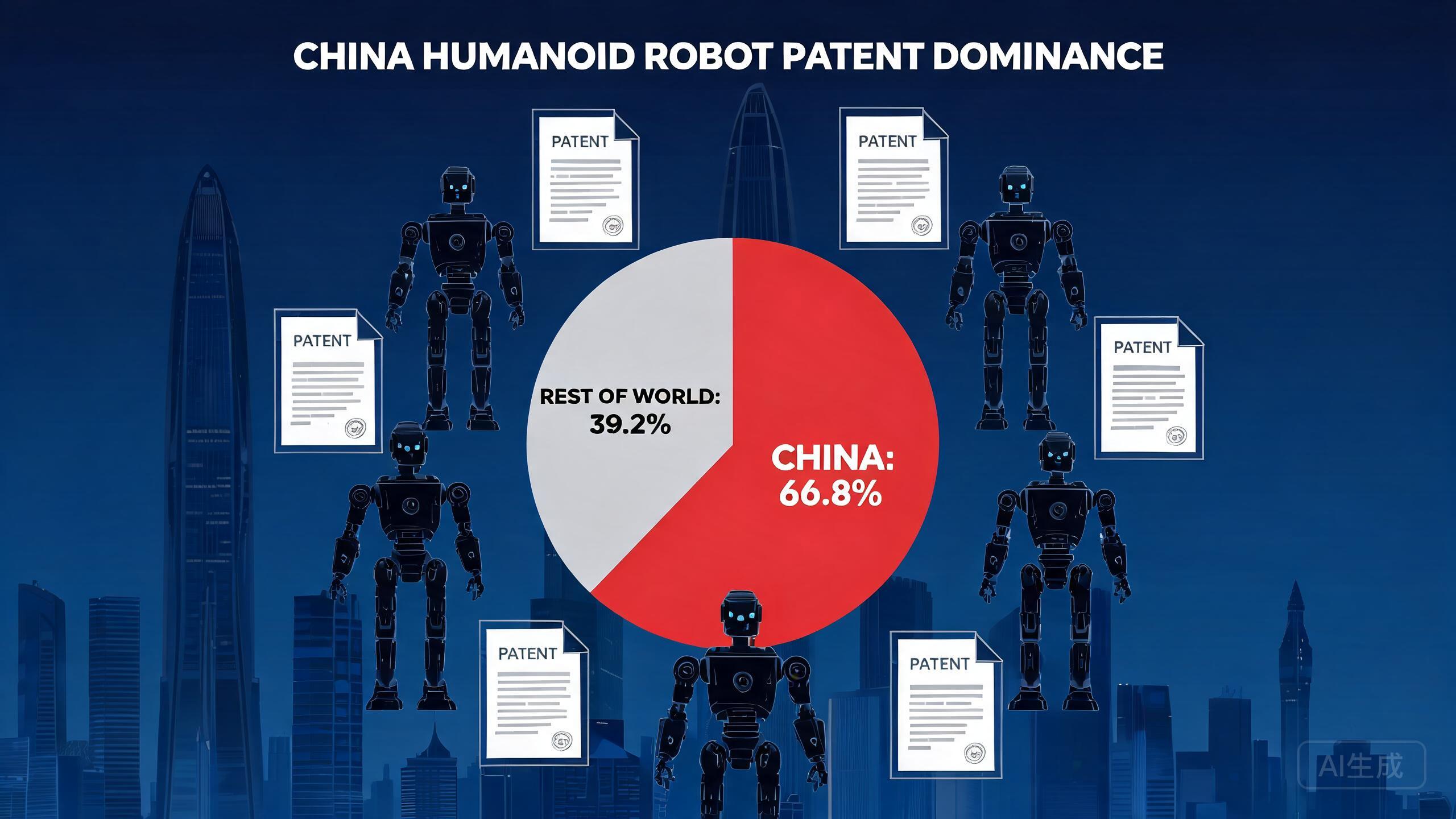
On September 28, 2026, China's Ministry of Industry and Information Technology released new data showing that Chinese academic institutions and companies now hold 60.8 percent of all global humanoid robot patents — up from approximately 52 percent one year earlier. China filed more than 34,000 humanoid-related patents in 2025 alone.
The rapid growth reflects China's national push into humanoid robotics, where dozens of provincial and municipal governments have set up industry funds, demonstration zones, and procurement programs. The Ministry's report highlighted progress in key technology areas including servo motors, harmonic reducers, tactile sensors, and embodied AI models — areas where China was historically dependent on imports from Japan, Germany, and the US.
Industry analysts cautioned that patent volume does not directly translate to technological leadership. Many of the new patents are incremental design registrations, utility model applications, or localized improvements rather than fundamental technology breakthroughs. US and Japanese companies still hold a disproportionate share of core patents in high-value areas like precision actuator design and control algorithms.
However, the gap is narrowing fastest in areas critical to scaling humanoid production: mass-manufacturable actuator designs, sensor fusion, and AI control systems. China's combination of manufacturing scale, government subsidies, and rapidly improving domestic AI creates a flywheel effect where production volume and software capability reinforce each other.
The patent data also reflects the breadth of China's humanoid ecosystem. More than 100 Chinese companies are now actively developing humanoid robots, ranging from startups like Unitree and Fourier to state-owned enterprises and consumer technology giants. This sheer number of players — supported by deep supply chain integration — makes it harder for any single international competitor to maintain a sustained technological advantage.
More than 100 Chinese companies are now developing humanoid robots — the sheer number makes it harder for any single competitor to maintain sustained advantage.
— Humanoid.Guide analysis
Related Robot
Unitree G1
Unitree Robotics
Related News
 央视网 / 双十一电商数据
China's Double-11 Robot Price War: First Humanoids Under ¥10,000 Hit Shelves as Makers Target Mass Market
China's November 11 shopping festival saw three humanoid robots priced under ¥30,000 ($4,150) for the first time, including Songyan Power's 'Little Bumi' at ¥9,999 — the first humanoid robot ever priced below ¥10,000. Unitree and Acceleration Evolution both launched ¥29,000 models. The aggressive pricing signals Chinese humanoid makers have entered a mass-market phase, targeting consumer and small-business buyers rather than just research labs and enterprise procurement.
 humanoid.guide
Chinese Regulators Slow Humanoid Robot IPOs After Unitree Stock Swing
In late September 2026, Chinese regulators began slowing the pace of humanoid robot company IPOs on the STAR Market after Unitree's stock experienced significant volatility following its record-breaking public debut. Regulators are scrutinizing valuations and revenue tied to local government-backed robotics projects. The move affects multiple humanoid startups in the IPO pipeline, potentially delaying their listing timelines.
 中国经济网 / Techiexpert
Unitree Achieves World's First Fully Autonomous Humanoid Combat with UnifoLM-X2
On September 7, 2026, Unitree Robotics demonstrated the world's first fully autonomous humanoid robot combat, powered by its UnifoLM-X2-1.0 world-action model. No human control, no teleoperation — the robot predicted opponent movements and planned counter-actions in real time. This marks a milestone in world-model-driven humanoid deployment, proving that real-time planning, decision-making, and dynamic interaction execution can work on physical hardware.