2026 Embodied AI Industry Report: China Enters 'Deployment Growth Phase' — from Demo to Normalized Real-World Operation
On October 30, 2026, the Xinhua Economic Information Agency and CAICT's Shanghai Industrial Innovation Center jointly published the 2026 Embodied AI Industry Innovation Report, declaring that China's embodied intelligence sector has entered a 'deployment growth phase' — transitioning from development demonstration to normalized real-world operation. The report benchmarks three capability levels for humanoid robots — L1 demonstration, L2 bounded deployment, L3 standardized production — and argues that the next phase of competition will focus on adaptability, not raw intelligence.

A landmark report dropped on October 30: the 2026 Embodied AI Industry Innovation Report, co-published by the Xinhua Economic Information Agency and CAICT's Shanghai Industrial Innovation Center, declared that China's embodied intelligence sector has formally entered the 'deployment growth phase.' The phrase is loaded — it means the industry is no longer judged on how impressive its demos look, but on how reliably its robots work in uncontrolled real environments.
The report introduces a three-level capability classification for humanoid robots: L1 is pure demonstration (can't handle unscripted environment changes), L2 is bounded deployment (works within predefined scenarios but fails at surprises), and L3 is standardized mass production (stable across multiple scenarios without constant human intervention). Most Chinese makers hover at L1; a few — AgiBot, UBTech, and Deep Robotics — have crossed into L2 with their Wuhan retail, household, and Hangzhou traffic-deployment trials. Nobody is yet at L3.
The authors argue that the next phase of competition will be defined by adaptability, not raw intelligence. The current generation of VLA and world models can handle any task you show them in a demo, but fall apart when the environment changes even slightly — a shelf is moved, a light dims, an object is placed at an unexpected angle. The gap between L2 and L3 is not about teaching robots more tasks; it is about teaching them how to recover when their assumptions are wrong.
The report's timing is deliberate. Six national humanoid standards take effect April 2027, the first Shanghai production-line trial just landed, CMG's Taishan Championship is about to conclude, and Xinye's Bubbo 1 has opened up a new home-market category. Every one of these events points to the same structural shift: China's embodied AI ecosystem is maturing from tech showcase to production infrastructure.
What makes the report noteworthy is not just the declaration but who made it: Xinhua and CAICT are policy-tied institutions whose reports set the agenda for government subsidy allocation and industry-level policy. When they say 'deployment growth phase,' they are signaling that government support will now favor makers who can prove real-world uptime, not just demo videos. The era of 'better demos' is officially over. The era of 'fewer breakdowns' has begun.
The era of better demos is officially over. The era of fewer breakdowns has begun.
— 《2026具身智能产业创新报告》/ 新华社 / 中国信通院
Related Robot
Agibot A3
Agibot
Related News
 工业和信息化部
China's MIIT Issues 2027–2029 Humanoid Robot Action Plan, Targeting 500,000 Units a Year
The Ministry of Industry and Information Technology published a three-year action plan for humanoid robots on November 23, 2026, covering 2027–2029. Targets include annual output of 500,000 units, an industry scale of ¥300 billion, 85% localization of core components, three to five globally competitive platform companies, and at least 100 demonstration projects each in automotive, electronics, logistics and elderly care.
 香港交易所 / 智元机器人招股书
AgiBot Files for Hong Kong IPO to Raise $1.5 Billion, Targeting a ~HK$100 Billion Valuation
AgiBot submitted a listing application to the Hong Kong Stock Exchange on November 17, 2026, seeking to raise about $1.5 billion at a targeted valuation of roughly HK$100 billion. The filing discloses ¥4.7 billion in revenue for the first nine months of 2026, a net loss of ¥1.1 billion, and cumulative humanoid production of more than 20,000 units, making it the largest humanoid IPO attempt after Unitree and Agility.
 高工机器人 GGII / 产业调研
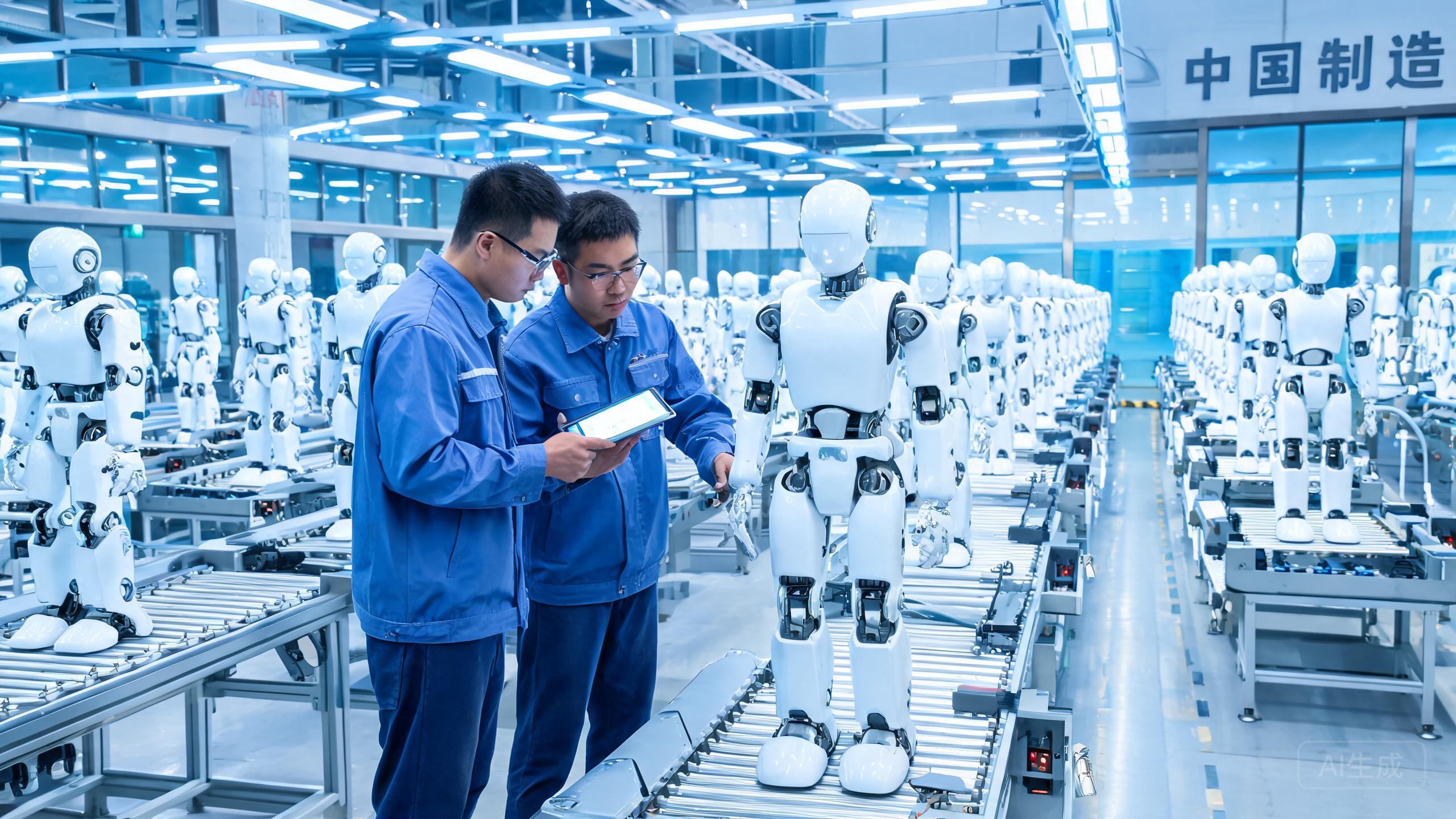
China's October Humanoid Output Hits 23,600 Units — GGII Raises Full-Year 2026 Forecast to 150,000
GGII data released on November 12, 2026 shows China produced 23,600 humanoid robots in October, up 18.4% month-on-month, bringing January–October output to 114,000 units. The research firm raised its full-year 2026 forecast from 100,000 to 150,000 units — its third upward revision this year — as average selling prices fell to ¥180,000 and Chinese makers held roughly 93% of global shipments.