RoboParty Unveils RP1: World's First Full-Stack Open-Source Humanoid at IROS 2026
On September 28, 2026, RoboParty publicly unveiled RP1 (ROBOTO 01) at IROS 2026 in Pittsburgh — the world's first high-performance full-stack open-source bipedal humanoid robot. Built on the RPO open-source project with 2,500+ GitHub stars, RP1 delivers up to 160 N·m peak joint torque via in-house Romomo actuators and features PartyOS with the UFO unsupervised reinforcement learning framework. The 'Kick Me' live demo proved its dynamic stability as it withstood pushes and kicks while maintaining posture. RoboParty plans to progressively open-source motion control, simulation, SDKs, and training tools, with mass production slated for Q4 2026.
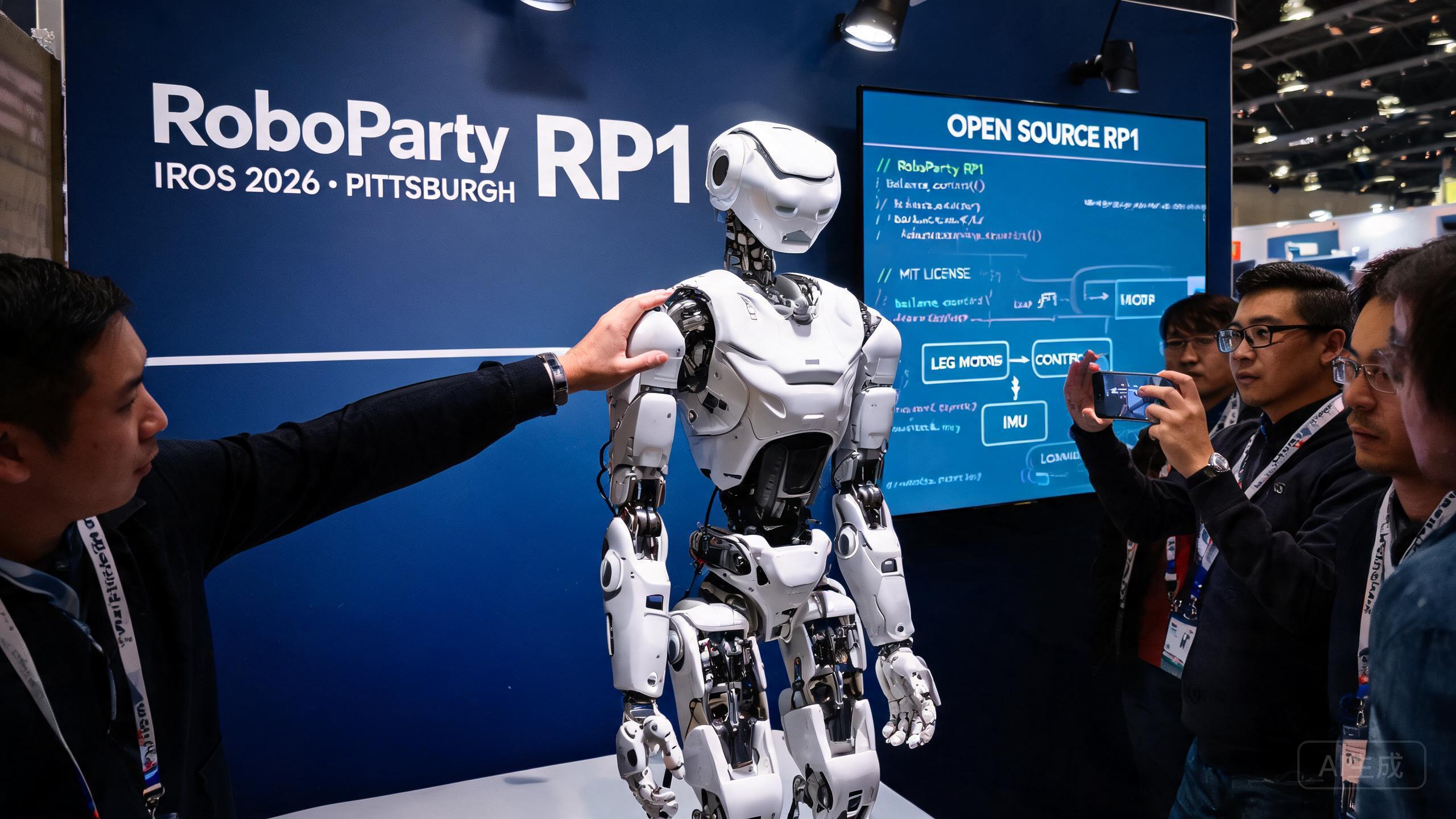
On September 28, 2026, RoboParty publicly unveiled RP1 (ROBOTO 01) at IROS 2026 in Pittsburgh, Pennsylvania — marking the global debut of what the company bills as the world's first high-performance full-stack open-source bipedal humanoid robot. The announcement builds on RPO (ROBOTO ORIGIN), RoboParty's fully open-source humanoid project launched in January 2026, which has already accumulated more than 2,500 GitHub stars and built a global developer community of over 5,000 members.
At the heart of RP1's performance are in-house-developed Romomo actuator modules and a real-time motion-control system that deliver peak joint torque of up to 160 N·m. The robot is powered by PartyOS — RoboParty's open R&D foundation for humanoid robotics — which integrates UFO, a training framework that discovers humanoid motor skills through unsupervised reinforcement learning. UFO covers skill transitions, disturbance recovery, and fall recovery without relying on predefined motion trajectories, enabling the robot to adapt naturally to unexpected physical interactions.
This robustness was put to the test live at IROS through the company's 'Kick Me' interactive demonstration. Visitors were invited to directly push and kick the robot, and RP1 rapidly adjusted its posture and recovered balance under these external disturbances — effectively demonstrating its dynamic stability, body performance, and system-level robustness in front of a live audience of robotics researchers and industry professionals.
RoboParty's vision of 'full-stack open source' goes beyond merely releasing mechanical design files. The company plans to progressively open its motion-control systems, simulation environments, SDKs, training tools, and the PartyOS development foundation. This means developers can participate at every layer — from hardware and low-level control to model training and deployment — creating a truly open ecosystem for humanoid robotics innovation.
The core team behind RoboParty includes graduates from Tsinghua University's Yao Class, Peking University's Zhi Class, Harbin Institute of Technology, Stanford University, Carnegie Mellon University, and Zhejiang University. RoboParty will announce further details of RP1's open-source roadmap in October 2026, with broader software and hardware releases and a mass-production program to follow later in Q4 2026.
Humanoid robots should not be closed systems that only a small number of teams can build while everyone else can do little more than watch.
— Yi Huang, Founder of RoboParty
Related Robot
RoboParty RP1
RoboParty